Digital Passport

A digital passport (DP, or just 'passport') is an IT-system (component) whose main function is to securely store data that pertains to a single entity (called the subject of the DP), and to execute code (called scripts') that enables such data to be created, read, updated, deleted, archived, etc.
DPs can be diversified, e.g., into (generic) 'digital product passports', such as (more specifically): 'digital battery passports', 'digital car passports', etc.Besides the ability to create, read, update and delete data, DPs can have many other functions, provided the corresponding scripts are available. Such functions might be, e.g., combining and/or anonymizing data, listing the kinds of data or scripts that are available within a DP, providing data that can be used to identify the DP's subject, participating in cryptographic multi-party computation protocols, etc.
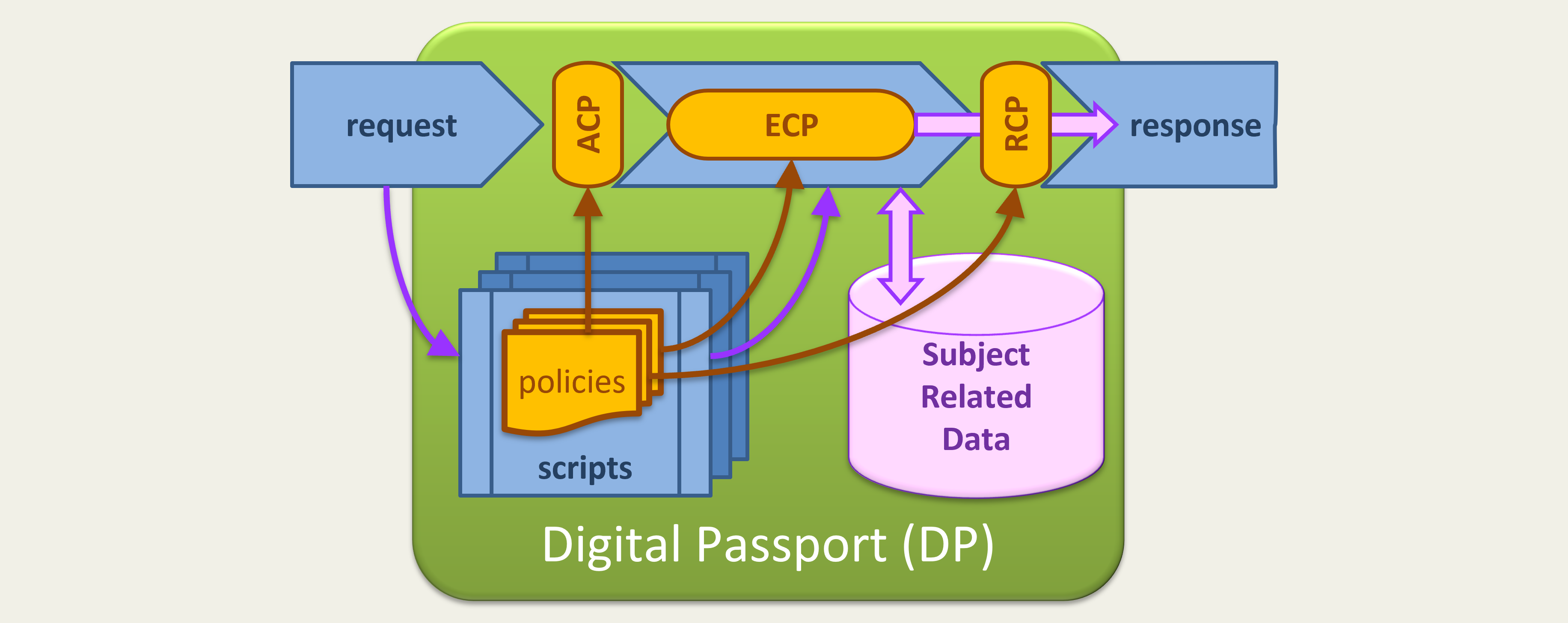
A DP has machine interfaces (APIs) and human interfaces (UIs) that enable it to receive requests for the execution of a script. Also, it has access-control policies (ACPs) that it uses to determine whether or not to service such requests, execution-control policies (ECPs) that it uses to guide the execution of scripts, and response-control policies (RCPs) that it uses to construct responses for the request and to determine where to send them to and what communications channel/protocol to use.
All this is illustrated in the figure below:
A DP can be in two states.
- In its initial (unbound) state, it isn't bound to any entity – it has no subject. In this state, a default set of scripts, policies, and data can be installed. Which they are would depend on the kind of entity for which the DP exists and be specified by the rules in the framework that is maintained by the appropriate governance processes.
- In its final (bound) state, the DP is bound to precisely one entity (its subject), and it remains bound to that entity until the DP ceases to exist.